


Tumor vs Cancer: What Is the Difference? | MOC Cancer Care
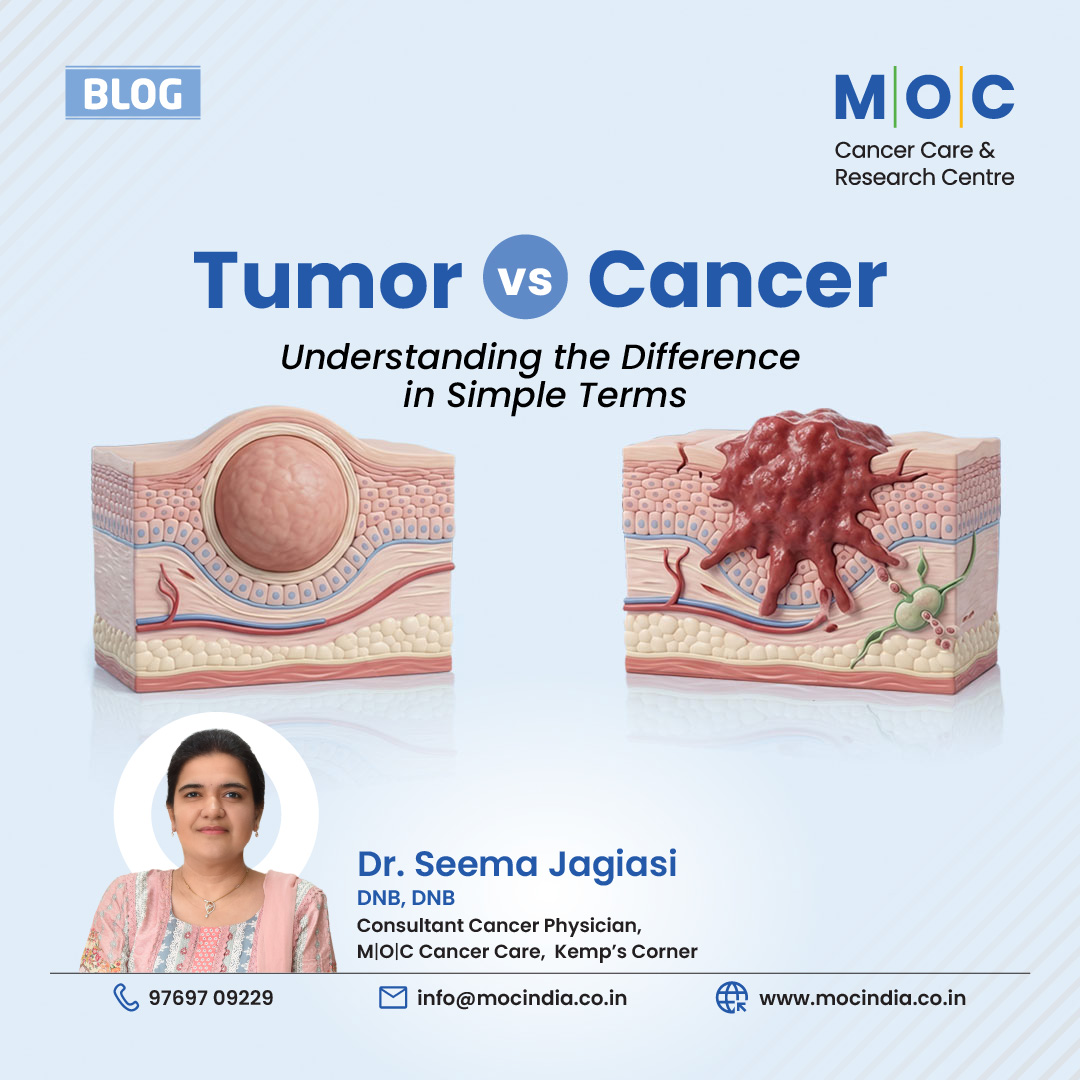
A tumor does not always mean cancer. This is one of the most common misconceptions among patients and families in India. When a scan or examination reveals a “tumor” or “growth,” the immediate reaction is often fear. But medically, a tumor simply refers to an abnormal growth or mass of cells. It may be benign (non-cancerous) or malignant (cancerous). Understanding this difference is important because not every lump requires cancer treatment, while a suspected cancer should not be ignored or delayed.
What is a tumor?- The human body constantly produces new cells and removes old or damaged ones. This process is normally controlled. Sometimes, cells multiply abnormally and form a mass or growth. This is broadly called a tumor.
Tumors are mainly classified as:
- Benign tumors: Non-cancerous
- Malignant tumors: Cancerous
So, the simplest way to remember it is: every malignant tumor is cancer, but every tumor is not cancer.
The World Health Organization's classification also distinguishes neoplasms according to their behaviour, including benign, malignant and those where the behaviour is uncertain.
What is a benign tumor?
A benign tumor is not cancer. These tumors generally remain in the place where they originated and do not invade surrounding tissues or spread to distant organs. Some may grow slowly and may never cause any symptoms.
Examples include some lipomas, fibroids and adenomas.
However, benign does not necessarily mean that the growth can always be ignored.
A benign tumor can cause problems if it becomes large or presses on an important organ, nerve or blood vessel. For example, even a non-cancerous growth in the brain can cause significant symptoms because the skull provides very little room for expansion.
Depending on its size, location and type, a benign tumor may simply be monitored or may require treatment.
What is cancer?
Cancer is a disease in which abnormal cells grow uncontrollably and can invade surrounding tissues and, in some cases, spread to distant parts of the body. This spread is known as metastasis. A cancerous growth is called a malignant tumor when it forms a mass.
However, it is important to understand that not all cancers form a solid tumor. Some blood cancers, such as leukaemia, involve abnormal blood-forming cells rather than one solid mass. This is why “tumor” and “cancer” should not be treated as interchangeable words.
Tumor vs cancer: What is the difference?
| Tumor | Cancer |
|---|---|
| An abnormal growth or mass of cells | A disease involving abnormal, uncontrolled cell growth |
| Can be benign or malignant | Cancer is malignant |
| A benign tumor generally does not invade or spread | Cancer can invade surrounding tissues and may spread |
| May require only observation | Usually requires appropriate cancer-specific treatment |
| Not every tumor is cancer | Cancer may or may not form a solid tumor |
The key difference is the behaviour of the abnormal cells- particularly their ability to invade surrounding tissue and potentially spread to other parts of the body.
Why is this distinction important in India?
Cancer is already a significant health concern in India. Estimates from the ICMR-National Cancer Registry Programme (NCRP) projected approximately 15.7 lakh new cancer cases in India in 2025. Breast cancer was estimated to account for about 2.39 lakh cases, followed by lung cancer and oral cancer among the leading cancer sites.
With cancer becoming increasingly visible in Indian families, the word “tumor” can understandably create immediate anxiety. But fear can sometimes lead to two opposite mistakes:
The first is unnecessary panic: assuming that every tumor or lump is cancer. The second is false reassurance: assuming that a lump is harmless and delaying medical evaluation. The right approach is neither panic nor neglect- it is proper diagnosis.
Can you tell whether a tumor is cancerous by its symptoms?
Usually, you cannot determine this just by looking at or feeling a lump. A cancerous growth can sometimes be painless, while a benign condition can cause pain. Some tumors grow slowly, while others may grow more quickly.
Depending on its location, a person may experience:
- A new or persistent lump
- Unexplained swelling
- Persistent pain
- Unexplained weight loss
- Unusual bleeding
- Persistent cough or change in voice
- Difficulty swallowing
- Changes in bowel or bladder habits
- Unexplained or persistent fatigue
Importantly, these symptoms can also occur due to many non-cancerous conditions. Therefore, symptoms alone cannot establish whether a tumor is cancerous.
How do doctors determine whether a tumor is cancer?
The evaluation depends on where the growth is located and what the doctor suspects.
- Clinical examination- The doctor considers the patient's symptoms, medical history, family history and examines the affected area.
- Imaging tests- Depending on the situation, doctors may recommend an ultrasound, mammogram, CT scan, MRI or other imaging test. Imaging can tell doctors a great deal about the location, size and characteristics of a growth. However, an imaging scan does not always provide the final diagnosis.
- Biopsy- A biopsy involves taking a sample of tissue and examining it under a microscope.
When cancer is suspected, pathological examination of the tissue is often essential for establishing the diagnosis and determining the type of cancer.
The exact diagnostic approach varies according to the organ and suspected disease.
Does every tumor need to be removed?
No. Some benign tumors that are small, stable and not causing symptoms may simply require observation and periodic follow-up. Treatment may be considered if the tumor grows, causes symptoms, affects the functioning of an organ or requires removal for diagnostic reasons. If the growth is cancerous, treatment depends on factors such as the type of cancer, stage, molecular characteristics, location and overall health of the patient. Depending on the situation, treatment can include surgery, radiation therapy, chemotherapy, hormone therapy, targeted therapy or immunotherapy. Modern cancer treatment is increasingly personalised rather than being the same for every patient.
When should you see a doctor?
If you notice a new, unexplained or persistent lump or swelling, it is sensible to have it evaluated rather than trying to determine its nature yourself. This is particularly important if the lump is increasing in size or is associated with symptoms such as unexplained weight loss, persistent pain, bleeding or changes in normal bodily functions. Early evaluation does not mean that you have cancer. It simply means that you are finding out what the problem actually is.
Frequently Asked Questions
- Is every tumor cancer?- No. Tumors can be benign or malignant. A benign tumor is not cancer.
- Can a benign tumor become cancerous?- Most benign tumors do not become cancerous. However, certain types of abnormal growths can carry a risk of malignant transformation, so the specific diagnosis matters.
- Is every lump a tumor?- No. A lump can have several causes, including infection, inflammation, cysts and other non-cancerous conditions.
- Can cancer occur without a tumor?- Yes. Some cancers, particularly certain blood cancers such as leukaemia, do not typically form a solid tumor.
- Does a biopsy mean that cancer has already been confirmed?- No. A biopsy is a diagnostic procedure used to examine tissue and determine what a growth actually is. It may be recommended when cancer is suspected, but undergoing a biopsy does not itself mean that cancer has been confirmed.
Conclusion: Don't fear the word “tumor”- understand it
The most important thing to remember is simple: Tumor does not automatically mean cancer. A tumor may be benign or malignant, and the distinction can often only be made through appropriate medical assessment and, when required, imaging and tissue examination. At the same time, a new or persistent lump should not be ignored simply because it might be benign. For patients and families, the best approach is early evaluation, accurate diagnosis and treatment based on the actual condition- not fear or assumptions.
Have you or a family member discovered a lump or been told there is a tumor? Don't jump to conclusions. Seek an appropriate medical evaluation and understand the diagnosis before deciding on treatment.
Contact M|O|C Cancer Care- 9769709229
Dr. Seema Jagiasi
DNB ,DNB
Consultant Cancer Physician
MOC Cancer Care & Research Centre, Kemps Corner .
Latest Blogs
-
![Multiple Myeloma: When Routine Clinical Findings Point to a Plasma Cell Disorder]()
- 14th Oct, 2026
- Multiple Myeloma: When Routine Clinical Findings Point to a Plasma Cell Disorder
-
![5 Healthy Habits That Don't Prevent Liver Cancer]()
- 12th Oct, 2026
- 5 Healthy Habits That Don't Prevent Liver Cancer
-
![One Breast Bigger Than the Other: Normal or a Warning Sign?]()
- 8th Oct, 2026
- One Breast Bigger Than the Other: Normal or a Warning Sign?
-
![Peau d’Orange: Orange-Peel Skin and Breast Cancer Signs]()
- 7th Oct, 2026
- Peau d’Orange: Orange-Peel Skin and Breast Cancer Signs
-
![Second-Hand Smoke: Can Your Neighbour’s Cigarette Harm You?]()
- 7th Oct, 2026
- Second-Hand Smoke: Can Your Neighbour’s Cigarette Harm You?
-
![1.9 Lakh Cancer Cases in India Linked to Infections: What to Know]()
- 6th Oct, 2026
- 1.9 Lakh Cancer Cases in India Linked to Infections: What to Know


.jpeg)

.jpeg)

Book Your Appointment